


Events
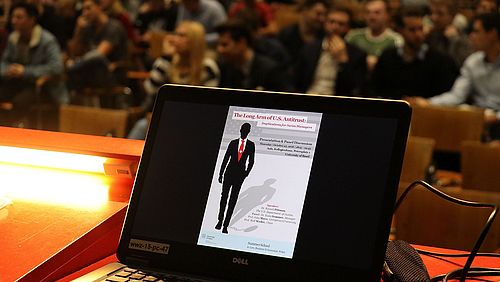
The Summer School in Law Business and Economic Policy organizes a Public Event once a year. We invite guest speakers from the US and Switzerland with the aim of discussing a current political or economic topic from various perspectives. The panel discussion is open to all members of the University of Basel, students as well as the interested public.
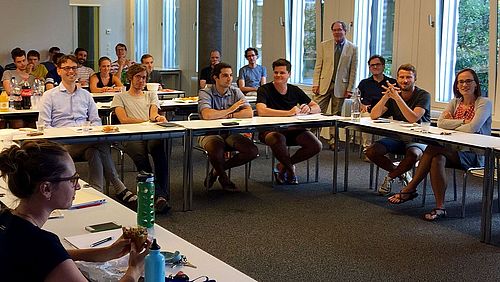
Additionally, during the time of the Summer School a series of Research Events are conducted with the aim of engaging junior and senior members of the faculty as well as for the fellow colleagues from the Summer School. Current research is presented and discussed involving Ph.D. students and members of the faculty. The research events are productive meetings, strengthening the scientific network and exchanging new ideas.
Finally, in 2022, the Summer School has launched a Lecture Series in Law and Economics - a joint project of the Faculty of Business and Economics, the Faculty of Law, and the Research Network Responsible Digital Society.
Wednesday, 1 July 2026, 17:00 - 18.15
«Algorithmic Price Discrimination: A Quasi-Experimental Investigation»
Speaker: Prof. Oren Bar-Gill, School of Law, New York University and Visiting Professor at the Summer School of Business, Law and Economic Policy
Host: Prof. Georg Nöldeke
Faculty of Business and Economics, Peter Merian-Weg 6, 4052 Basel
Seminar room: S 17
Abstract:
Algorithmic price personalization is rapidly moving from theory to market reality. Neoclassical economics views such first-degree price discrimination favorably—it eliminates deadweight loss, expands output, and can redistribute surplus toward lower-willingness-to-pay (WTP) consumers. Behavioral economics is more skeptical, warning that algorithms may charge higher prices to less sophisticated consumers who overestimate a product's net benefit. We study how algorithmic pricing works in practice. Because real-world pricing algorithms are proprietary, we construct two proxies: a white-box algorithm with explicitly-specified logic, and an algorithm based on publicly available Large Language Models. Both quickly learn to price discriminate, infer WTP from purchase histories, and use exploratory offers to refine their estimates. When a consumer's WTP fluctuates over time—reflecting behavioral states rather than preferences—the algorithms identify moments of peak WTP and time offers accordingly, providing suggestive evidence that algorithmic pricing can be welfare-reducing. We evaluate two code-based interventions: caps on permissible price variation, and prompt-based prohibitions on exploiting behavioral components of WTP. Preliminary results suggest both can meaningfully constrain algorithmic harm.
Thursday, 16 July 2026, 12:30 - 13:45
"The Limits to Institutional Arbitrage: Resource Fungibility, External Agglomeration and Regional Collocation"
Speaker: Prof. Heather Berry, McDonough School of Business, Georgetown University and Visiting Professor at the Summer School of Business, Law and Economic Policy
Hosts: Prof. Alois Stutzer
Faculty of Business and Economics, Peter Merian-Weg 6, 4052 Basel
Seminar room: S15
Abstract:
We analyze the persistence of institutional arbitrage investments by multinational corporations (MNCs) following a policy change that reduces the institutional benefits from operating abroad. Our core argument is that the decision to relocate activities after a policy change will vary by the fungibility of the activity, the agglomeration benefits of the country and the extent of a firm’s internal regional collocation. Results from difference in differences analyses of changes in US MNC investments in tax haven countries following the Tax Cuts and Jobs Act of 2017 show that the effects of this policy change were limited to more fungible investments (cash) in countries with low agglomeration benefits; less fungible investments (R&D, product and service transfers) were not reduced, especially for firms with collocated regional operations.
Wednesday, 12 August 2026, 18:15 - 19:30
Public Event on Artificial Intelligence
Speaker: Prof. Stephen Weymouth (McDonough School of Business, Georgetown University), Host: Prof. Rolf Weder
Faculty of Business and Economics, Peter Merian-Weg 6, 4052 Basel,
Auditorium
Abstract:
Understanding the motivations behind antitrust laws remains important because courts continue to rely on legislative intent when interpreting these statutes. This paper revisits the origins of antitrust by examining why some states adopted antitrust laws before the Sherman Act of 1890. Using large-scale digitized newspaper data, machine-learning, and standard econometric methods, we measure anti-monopoly sentiment during the 1880s and connect it to states’ statutory choices. This approach allows us to test competing explanations for the rise of antitrust and inform contemporary debates about its original purposes.
Quick Links
Social Media